From ground to sky: The evolution of in-flight connectivity
Advancements in satellite technology are bringing a ground-like connectivity experience to the airplane cabin

Global Services
Advancements in satellite technology are bringing a ground-like connectivity experience to the airplane cabin
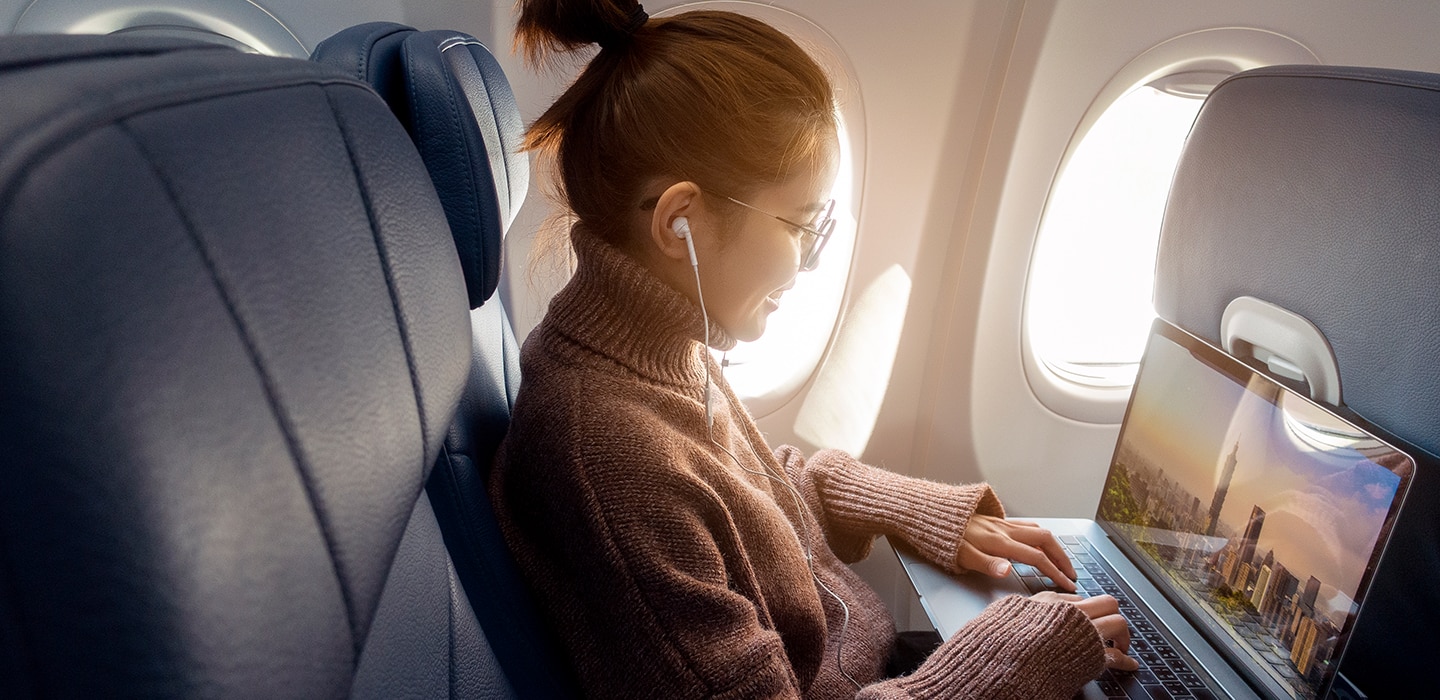
Planning to catch a flight anytime soon? There’s an increasingly good chance it will be Wi-Fi capable. The number of connected airplanes is growing rapidly and is expected to exceed 20,000 by the early 2030s, doubling from around 10,000 in 2022. While the in-flight connectivity (IFC) experience is still variable, the technology supporting IFC is rapidly improving. The days of struggling to connect multiple devices, share large files and stream high-definition video in-flight are ending as the journey from air-to-ground cell towers to geostationary (GEO) and now low Earth orbit (LEO) satellites begin to offer an experience akin to what’s available on the ground.
Early in-flight connectivity service relied on air-to-ground systems, which primarily utilized a network of cell towers positioned along flight paths. Satellite service launched at the same time, when Boeing offered airline passengers the opportunity to experience in-flight broadband access for the first time aboard a Lufthansa 747-400 equipped with Connexion by Boeing.
Connexion by Boeing initially leveraged Ku band antenna technology that was installed on the airplane and configured to connect to existing satellites and ground stations. The initiative set the stage for the future of in-flight connectivity and represented a major step forward in the passenger experience by enabling new ways for passengers to communicate, work, and entertain themselves.
Those early air-to-ground systems provided a basic level of in-flight connectivity, but the experience was far from seamless. Launched in the U.S., the service only worked when airplanes were flying over land, and passengers often experienced slow speeds and dropped connections.
The introduction of GEO satellites marked a leap forward in terms of providing a more reliable connection. These satellites, positioned more than 20,000 miles above the Earth, provided broader coverage and improved connectivity. Although more reliable, on their own GEO satellites came with a different set of limitations. Latency, or the lag associated with data moving across a network, still hindered real-time applications, such as video conferencing or online gaming. Additionally, the high cost of satellite bandwidth often means that airlines must balance pricing with the quality of service, often leading to limitations on data usage and high WiFi prices for passengers.
Today’s LEO satellites are quickly emerging as an antidote to latency and offer improved bandwidth at a lower cost. High-capacity LEO satellites are positioned much closer to the Earth—typically around 1,000 miles or lower, reducing latency and vastly improving the experience.
These recent advances in satellite technology together with new electronically steerable array antennas (ESA) being developed by leading IFC providers, offer a path to a fast, reliable and seamless on-board connectivity experience. ESAs can dynamically adjust to maintain a stronger connection to satellites. Importantly, ESAs are being designed to support LEO, or a combination of LEO and GEO satellites for a multi-orbit connection to reduce connectivity disruptions.
As airlines consider the exciting possibilities of this new technology, Boeing is actively developing solutions to integrate these advanced technologies onto commercial airplanes.
Connect with us at the Aircraft Interiors Expo (AIX) April 8-10 in Hamburg, Germany to learn more about how Boeing is working to improve the IFC experience.


