
Global Services
Global Services
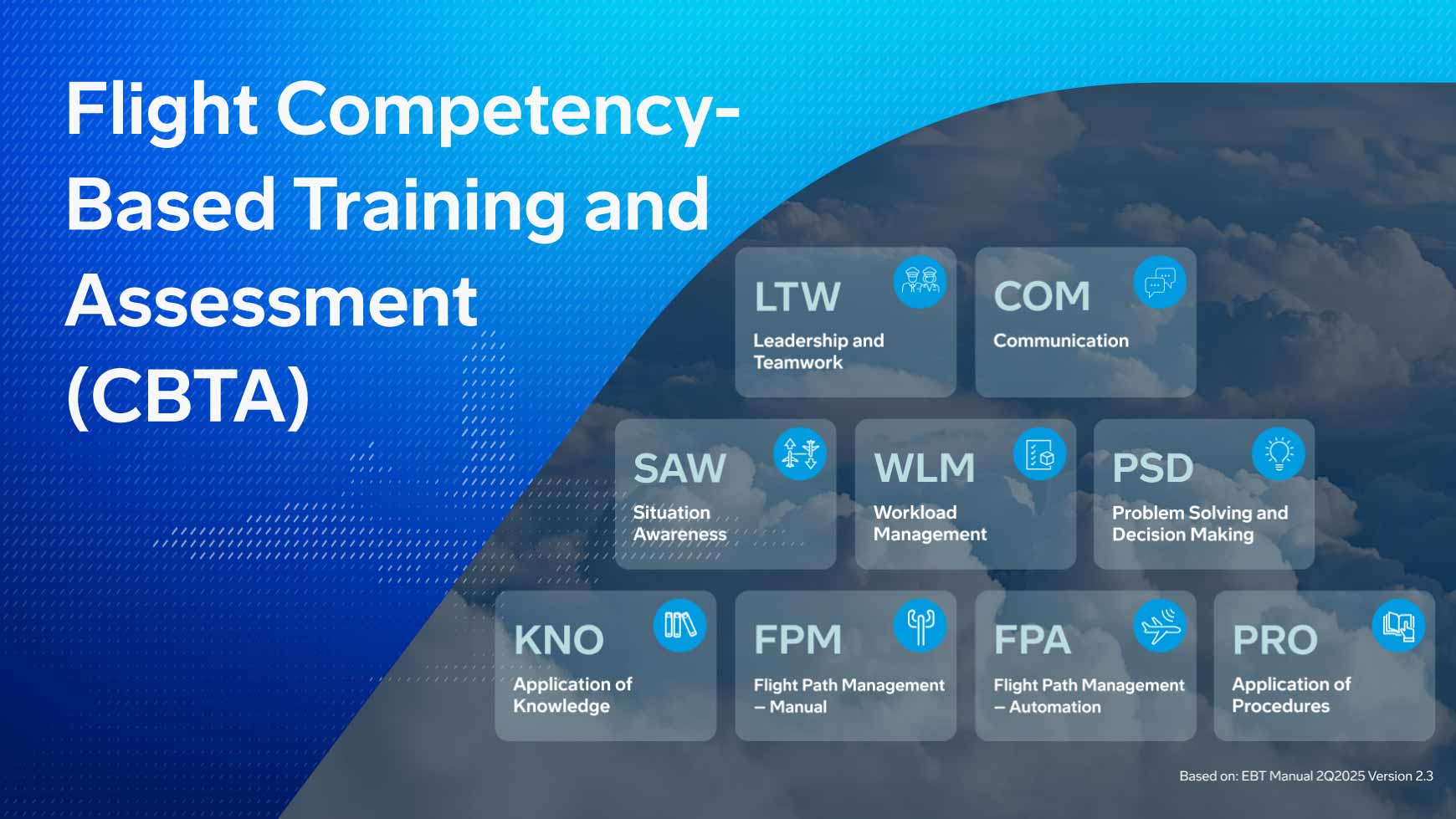
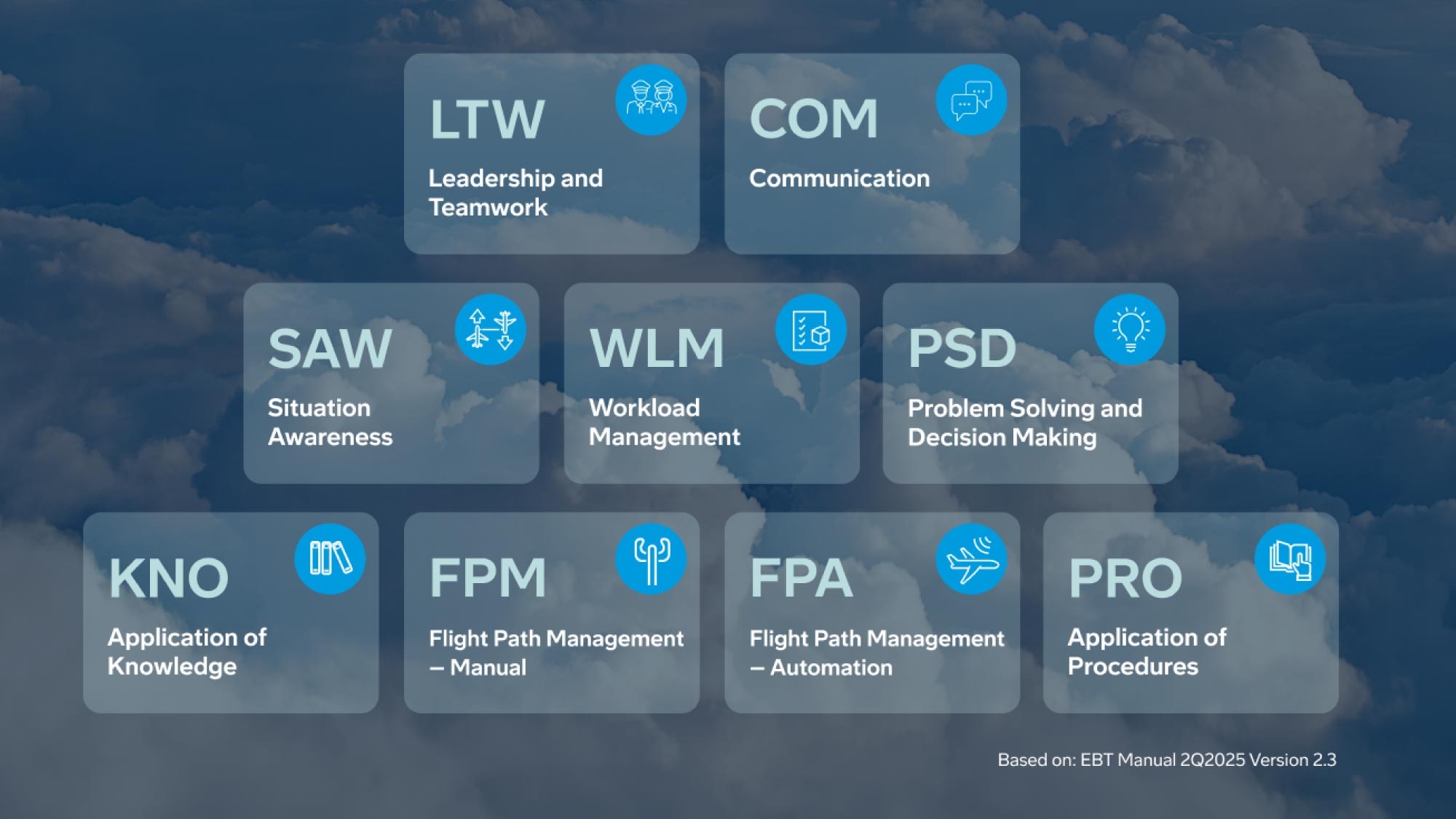
In CBTA, structured competency frameworks guide pilots and instructors to foster continuous improvement and operational excellence. CBTA emphasizes that core pilot competencies — such as flight path management, problem-solving, and leadership — are not standalone skills, but interconnected essentials for safe and effective performance.
These competencies evolve through real-world experience and are reinforced through targeted training. Pilot competencies are a shared mental model between pilots. They work as a standard for human-centered operating procedures, going beyond mere task completion to foster teamwork, work management, and awareness.
Boeing’s CBTA adapted framework utilizes both human factors and technical factors.

The foundation for instructors is to be able to demonstrate aptitude in the pilot competencies in their own operations and in their training.

Instructors must take steps to maximize attention, minimize distractions, and foster productive training as much as possible.

Instructors develop trainees’ competencies by applying different instructional methods (such as facilitation and discover without assistance) that continuously encourage trainees to meet the training objectives.

Instructors must encourage an open, facilitative, and welcoming training environment where trainees feel comfortable to ask for help and express their needs, concerns, and questions.

Instructors must be adept at CBTA/EBT assessment through a systematic process using: evidence observed during training, root-cause analysis of performance through observable behaviors (OBs), and data documentation to improve trainee learning and training curriculum.
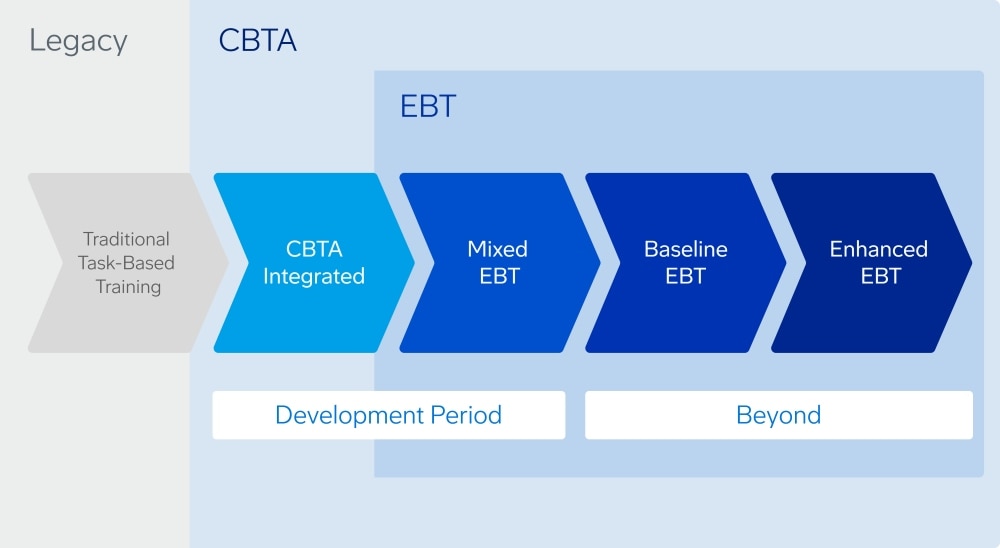 There is an evolutionary path from traditional legacy, task-based training toward more modern, performance-driven methodologies. CBTA and EBT show how training organizations progress through several stages starting with CBTA Integrated, in which CBTA principles are introduced alongside legacy methods.
The next stage, Mixed EBT, blends CBTA with initial elements of EBT. In Baseline EBT, CBTA is fully embedded and supported by evidence-based practices.
The final stage, Enhanced EBT, represents a future state. This progression emphasizes the industry's shift toward training models that prioritize real-world competencies, instructor calibration, and data-driven decision-making to enhance safety and operational readiness.
Boeing offers an array of services designed to support the successful implementation of CBTA across various training environments. Explore how our comprehensive offerings can enhance your training programs and operational safety.
What is CBTA in pilot training, and how does it differ from task-based training methods?
Competency-Based Training and Assessment (CBTA) is a training system that emphasizes the development and assessment of specific competencies necessary for effective performance. While task-based training remains a foundational element of aviation curricula, CBTA enhances and optimizes this approach by broadening the focus to include a more human-centered, comprehensive performance framework. This integration allows for a richer training experience that prepares pilots to effectively manage the complexities of real-world operations.
Does CBTA focus solely on observable behaviors?
While CBTA includes observable behaviors as part of its framework, it encompasses much more than that. These behaviors serve as important indicators of pilot success and contribute to a shared operational model. The primary goal of CBTA is to develop well-rounded pilots, incorporating higher-level knowledge, skills, and attitudes that are essential for effective flight operations.
How do the roles of trainees and instructors evolve in CBTA?
Trainees take an active role in their learning through self-assessment and collaboration with instructors, fostering ownership of their development. Instructors transition to facilitators of learning, guiding trainees and focusing on observation and support to enhance the learning experience.
How are assessments conducted in CBTA?
Assessments in CBTA are designed to provide meaningful insights into trainee performance. They focus on both formative and summative evaluations, allowing for regular feedback that supports learning and development. This approach ensures that assessments are constructive and aligned with overall training objectives.
What types of training programs can incorporate CBTA principles?
CBTA principles can be integrated into various training programs, including type rating courses, recurrent training, instructor training, and specialized leadership programs for training managers, ensuring a comprehensive approach to pilot and instructor development across both maintenance and flight training.
How can I begin my implementation journey with CBTA?
To start your implementation journey with CBTA, assess your current training programs and identify areas for alignment with CBTA principles. Engage with Boeing’s experts for guidance on developing a tailored implementation plan that includes training needs analysis, stakeholder engagement, and resource allocation.
What resources does Boeing provide to support CBTA implementation?
Boeing offers a variety of resources, including training materials, consultation services, and access to the Managing a CBTA-EBT Program, which equips training leaders with the skills necessary for effective CBTA integration.
Where has the Boeing CBTA program achieved regulatory approval?
Boeing has collaborated with various regulatory bodies, including the International Civil Aviation Organization, European Union Aviation Safety Agency, and Federal Aviation Administration, to achieve approval for its CBTA programs, ensuring compliance with industry standards.
Learn how the aviation industry is transforming pilot training and evaluation with Competency-Based Training and Assessment (CBTA) and Evidence-Based Training (EBT). These frameworks shift from traditional task-based methods to a data-driven approach, enhancing pilot development and career support.
The CBTA program enhances pilot resilience and mitigates risks by focusing on competencies—a broader skill set that empowers pilots to manage unforeseen situations and challenges.