Global Services
Global Services

When an aircraft is unexpectedly out of service, the impact reaches far beyond repairs. Unplanned maintenance can disrupt schedules, strain parts inventories, and put additional pressure on already stretched teams.
Predictive maintenance helps airlines and MROs get ahead of those disruptions by using aircraft data to anticipate maintenance needs, plan resources, order parts, and keep fleets available.
This shift toward proactive maintenance planning is becoming increasingly important. Boeing’s 2026 Services Market Outlook highlights several pressures on operators over the next two decades, including aging fleets, technician shortages, and supply chain constraints.
As fleets and aviation services become more complex, data and AI will play a growing role in how organizations manage aircraft health and maintenance.
Predictive maintenance uses both real-time and historical data to forecast when an aircraft component or system is likely to fail. Maintenance teams typically use it to identify emerging issues and detect component degradation, enabling earlier maintenance intervention.
The best way to use predictive maintenance is in tandem with reactive maintenance, which entails addressing faults and failures after they occur instead of before.
Some of the biggest benefits of predictive maintenance include:
To use predictive maintenance effectively, operators and MROs must have advanced technological capabilities. Sensors and connectivity capture telemetry from engines, avionics, and airframes, while cloud platforms, secure APIs, and AI aggregate and analyze that data to detect anomalies and estimate remaining useful life.
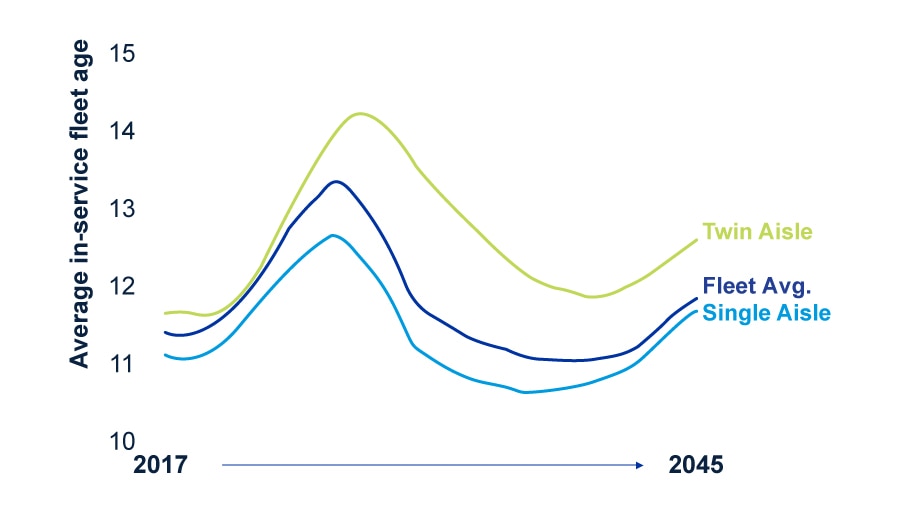
Historical and projected average ages of in-service fleets, 2017-2045
Several industry trends are making it more essential for aviation services organizations to adopt a predictive maintenance model.
For one, aircraft are staying in service longer and fleet replacement is becoming more gradual. As a result, more demand is shifting to the installed base, including midlife maintenance, component repair, and lifecycle optimization.
At the same time, aviation operations are growing more digital and more complex. By 2045, nearly 90% of the global fleet will be e-enabled, according to Boeing projections.
“Advances in connectivity, analytics, artificial intelligence, and automation are enabling operators to move from reactive decision-making toward predictive and optimized operations,” states the report.
Finally, short-term capacity constraints and technician shortages make unscheduled downtime costly for airlines and MROs, and proactive planning can help avoid it.
“Predictive maintenance is becoming mainstream as operators use aircraft health data to identify issues earlier, reduce unscheduled maintenance, and improve fleet utilization.”
— 2026 Boeing Services Market Outlook
Predictive maintenance requires sufficient planning and resources to be effective.
Here are two critical factors operators and MROs should consider when adopting a predictive maintenance model.
Data governance, cybersecurity, AI, and regulator-ready implementations are necessary for successful predictive maintenance. Without a strong technological foundation, airlines may struggle to ensure long-term growth and stability.
According to the report, to reap the full benefits of digital aviation services, organizations must build and maintain an “enterprise digital architecture that connects aircraft data, maintenance records, parts traceability, and operational workflows beyond onboard sensors and standalone applications.”
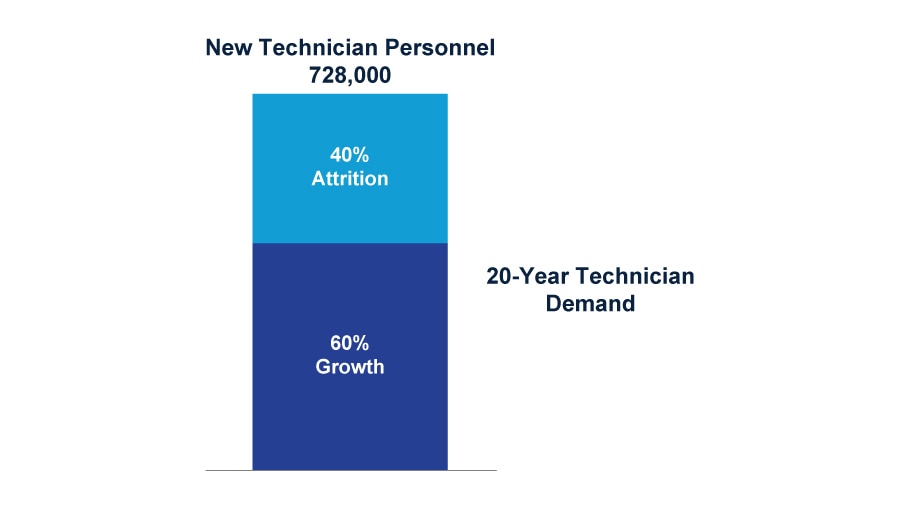
Projected demand for new aircraft technicians, 2026-2045
Predictive maintenance depends not only on data and software but also on people who can interpret insights and apply them to maintenance decisions.
Boeing’s Pilot and Technician Outlook projects that the aviation services industry will require more than 700,000 new technicians between 2026 and 2045. These professionals will need strong digital, analytical, and systems skills for operationalizing predictive workflows.
This means airlines and MROs are increasingly likely to prioritize hiring and training workers with a combination of maintenance and digital skills, including expertise in:
Predictive maintenance plays a crucial role in Boeing’s digital services.
The following products combine our deep aircraft and engineering expertise with proprietary aircraft data to deliver actionable insights for maintenance teams:
As predictive maintenance becomes a basic requirement, operators and MROs will need the technology and skilled workforce to effectively forecast maintenance needs, reduce costs, minimize disruptions, and improve parts planning.
Key requirements include:
With the right technology and people, predictive maintenance can deliver long-term gains.