Insights

Global Services
Global Services

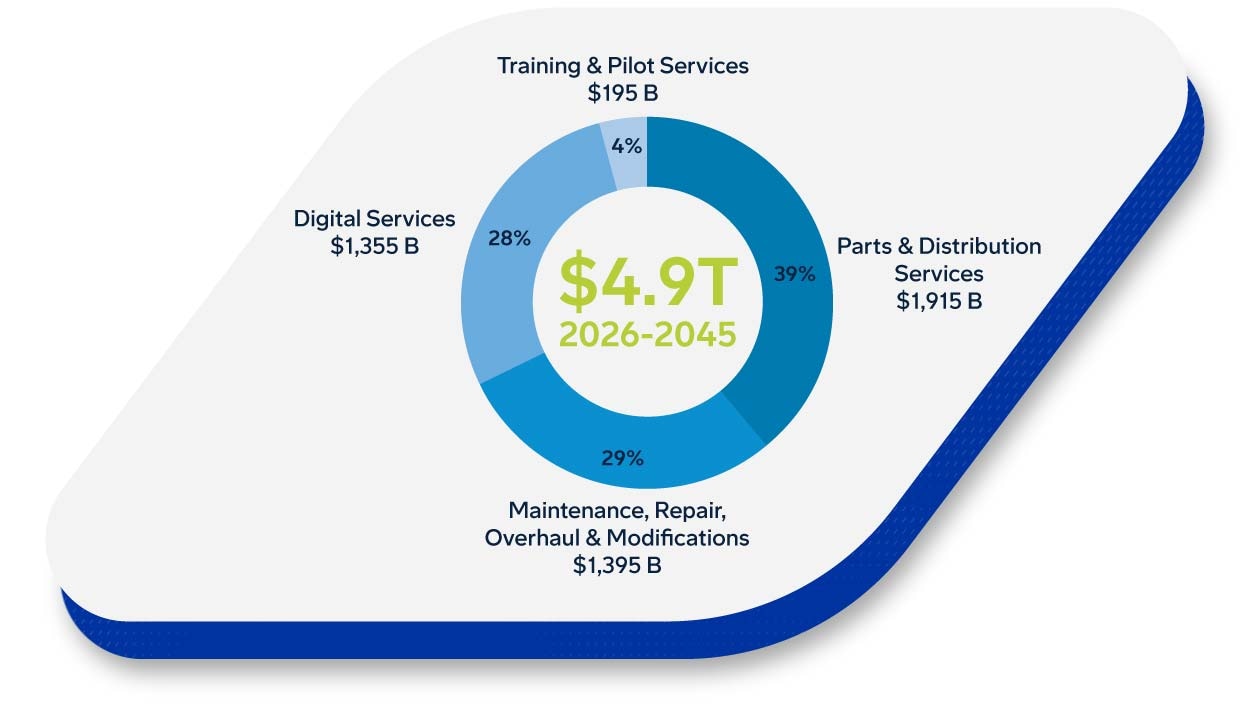
Projected aviation services market share by category, 2026-2045
For aviation services organizations to succeed, they must find ways to convert limited capacity into competitive advantage.
According to Boeing’s 2026 Commercial Services Market Outlook (SMO), the aviation services and support market is projected to be worth $4.9 trillion over the next 20 years.
Even with a promising long-term outlook, Boeing anticipates several industry challenges over the next two decades, including constraints on production and parts, a rise in aging fleets, and a shortage of skilled personnel.

Global services market outlook by region
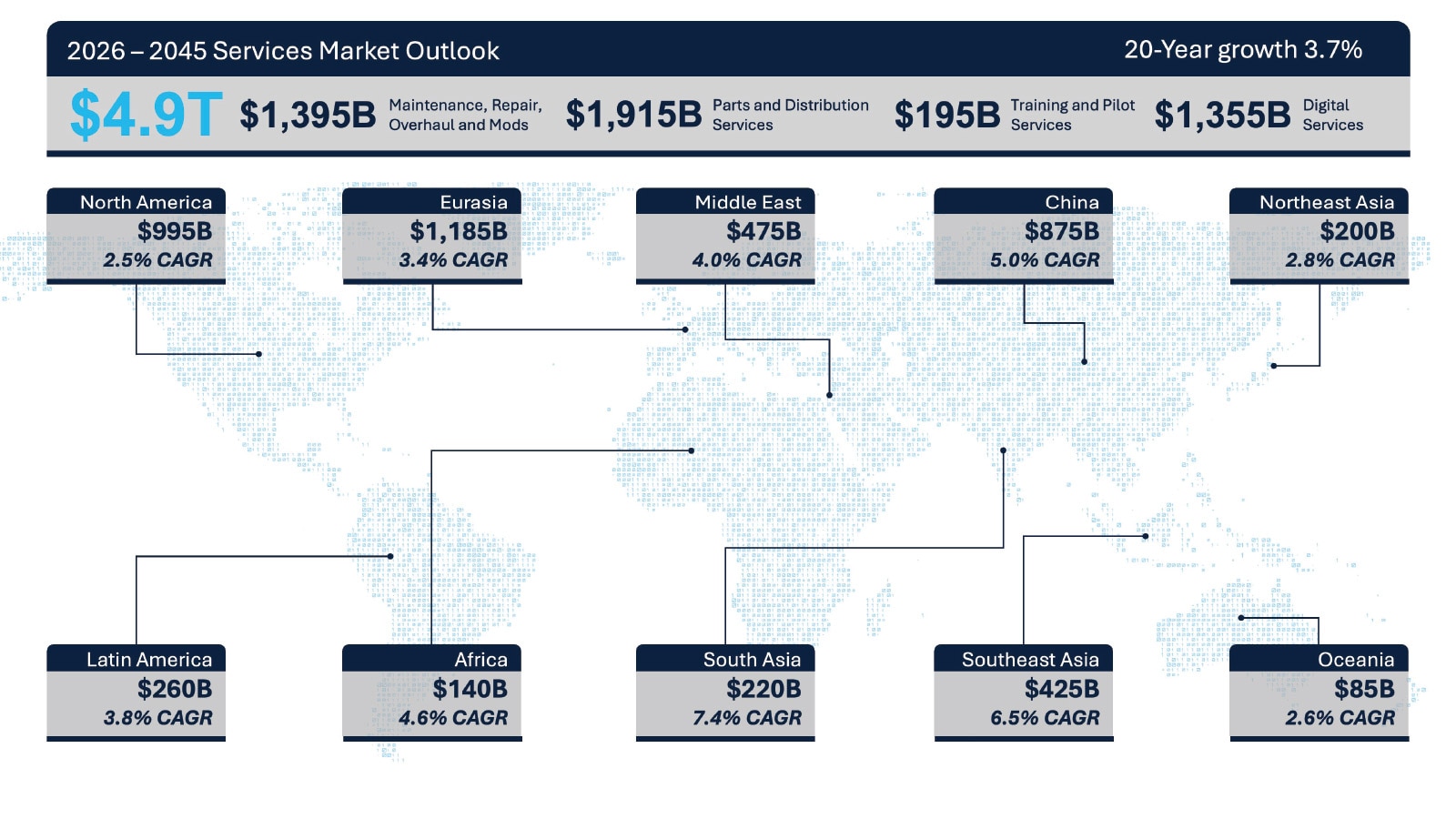
CAGR = compound annual growth rate
According to the report, capacity — not demand — now stands as the greatest constraint on aviation services market growth.
While demand for shop visits, engine overhauls, heavy maintenance, and rapid AOG response is rising, organizations may struggle to keep up in the near term due to barriers such as:

With capacity posing big challenges for the next decade, lifecycle strategy will play a central role in decision-making and cost planning.
Market growth will depend on how effectively the industry preserves aircraft availability in a more constrained operating environment.
— Boeing 2026 SMO
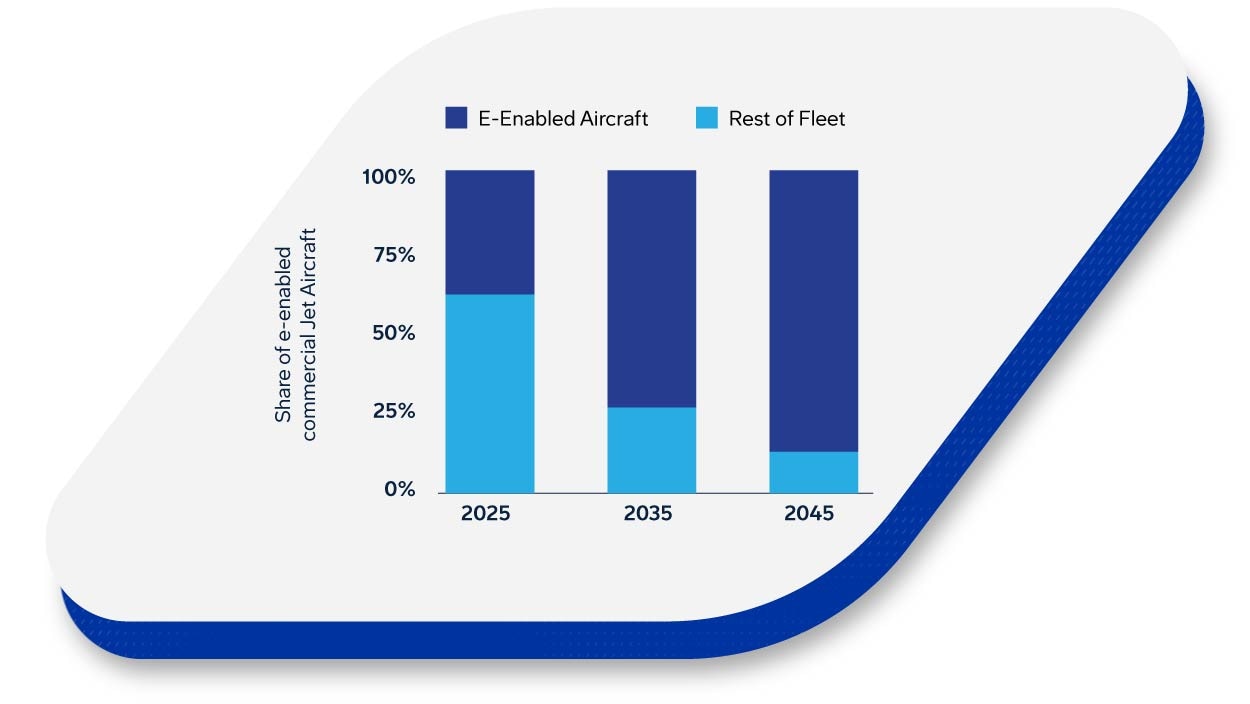
In 2025, around 1 in 3 commercial jet aircraft were e-enabled. By 2045, nearly 90% of aircraft will be e-enabled, according to Boeing’s aviation forecast.
This rise is primarily due to shifts in how the aviation services industry uses data, AI, and other digital tools. More operators are relying on AI to diagnose and analyze technical records.
More opportunities to utilize data are also leading more organizations to prioritize predictive maintenance.
Furthermore, the rate at which digital adoption grows will vary by region. Boeing projects that North America and Eurasia will account for nearly half of global digital services demand over the next 20 years.
The recent explosion in digitalization and AI points to positive changes on the horizon, including increased reliability, fewer disruptions, and more streamlined global flight operations.

In aviation, sustainability primarily used to mean reducing carbon emissions. Now, the conversation has expanded to include lifecycle optimization and efficiency.
Because fleets remain in service longer, teardown activity will increase, creating more opportunities for remanufacturing and parts reuse. This also means that the Used Serviceable Materials market will likely expand.
The emerging prioritization of component recycling, reuse, and resource efficiency signals an industry evolution toward a more optimized circular supply chain.
The aviation ecosystem will increasingly emphasize asset reuse, repair, recycling, and lifecycle optimization.
— Boeing 2026 SMO
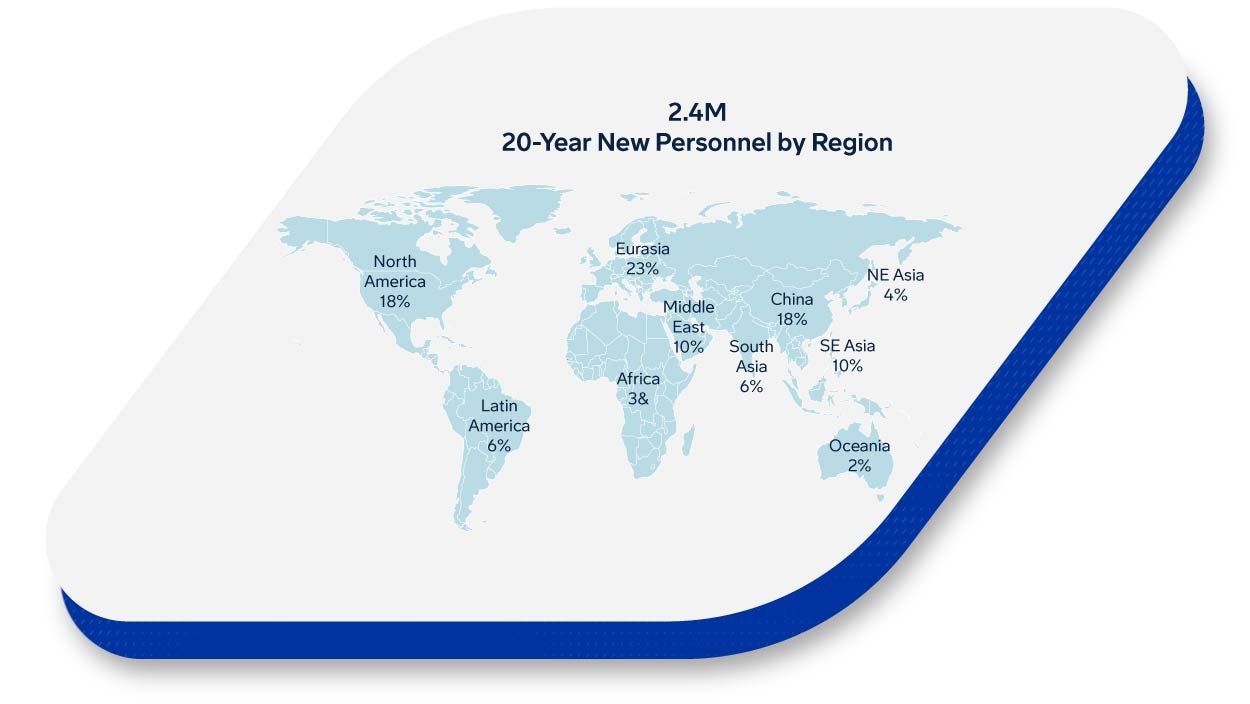
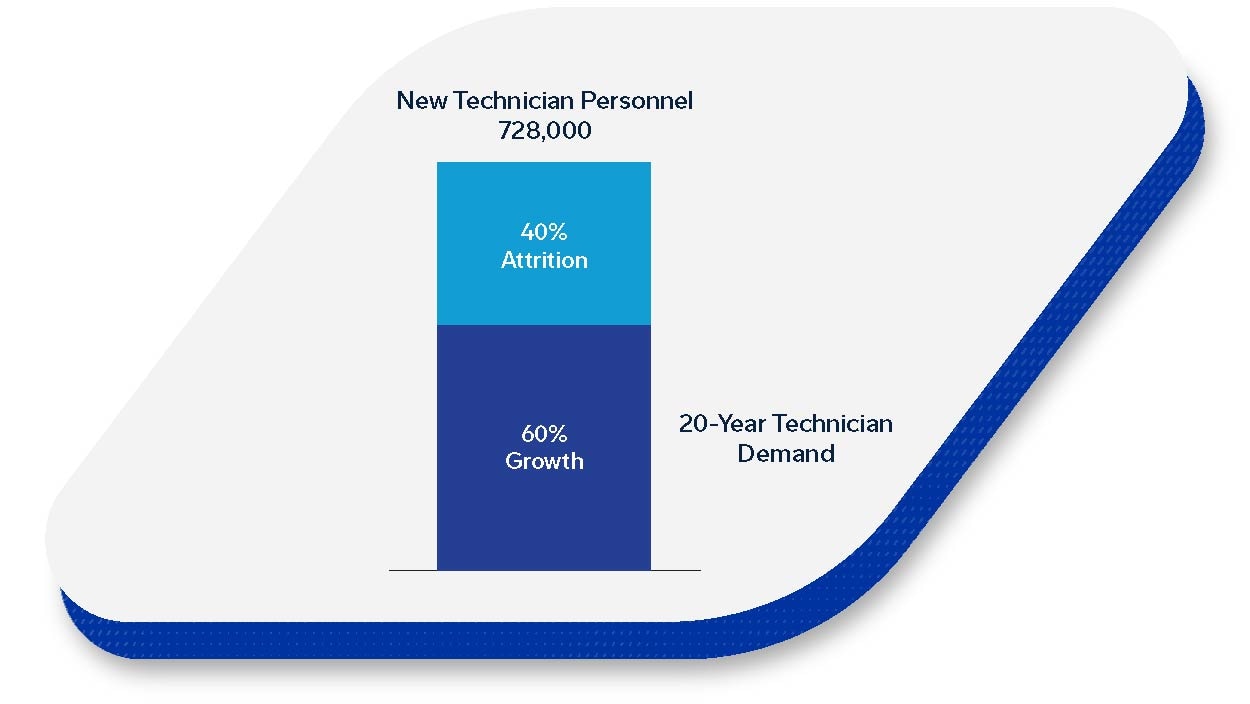
Increased air travel, an expanding fleet, and more workers nearing retirement continue to drive demand for skilled aviation professionals.
According to the 2026 Boeing Pilot and Technician Outlook, the global commercial aviation industry will require millions of new pilots, technicians, and cabin crew members over the next two decades.
Around 60% of that demand stems from just three regions:
For airlines, notable challenges include short-term labor shortages and a rise in workforce juniority as senior-level professionals retire.
Additionally, operators will need professionals who are adept at analyzing data, using digital tools, and applying skills honed through Competency-Based Training and Assessment (CBTA) courses.
The increasing demand for aviation professionals signals an industry need to strengthen its talent pipeline development, retention, and training.
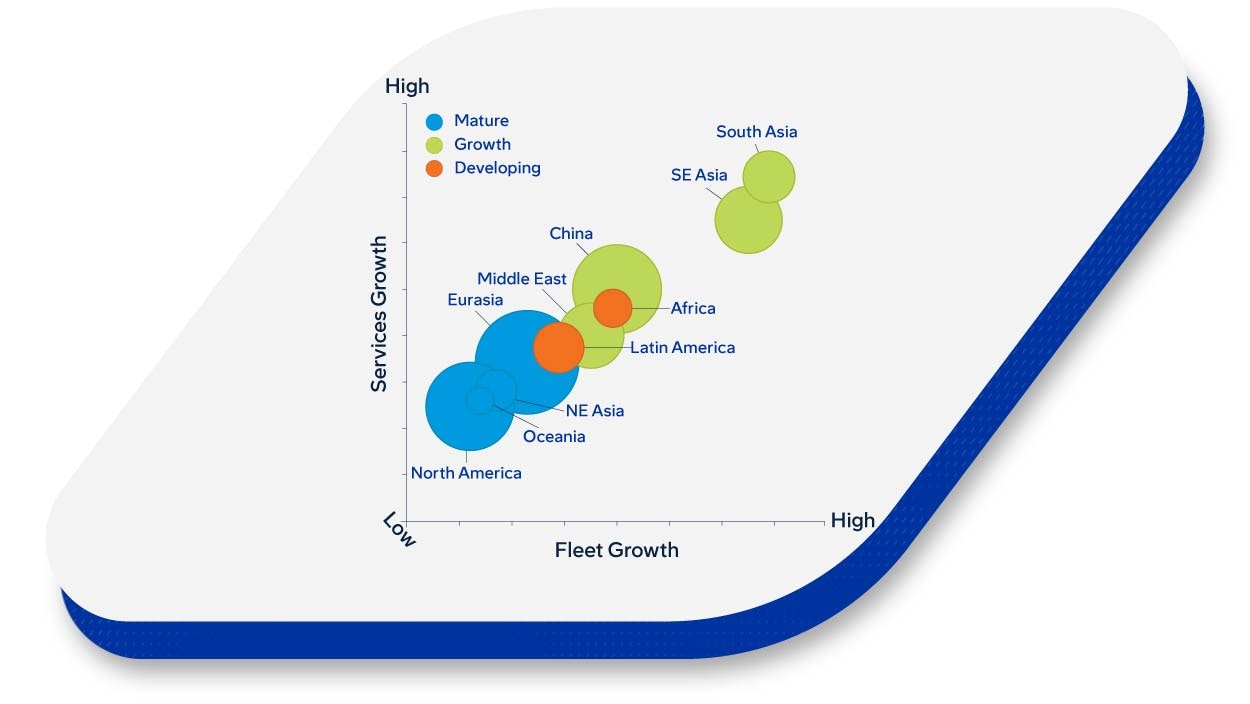
New aviation centers are starting to emerge outside traditional hubs as carriers, MROs, and suppliers invest where fleet growth and demand are most concentrated.
Markets in Asia, the Middle East, Latin America, and Africa are developing maintenance, training, and parts-distribution capabilities to serve local and regional fleets. For local operators, this trend will likely lead to reduced AOG time, lower logistics costs, and expedited turnaround time.
Regional aviation centers mean faster, lower-cost services for local operators, with notable growth projected in the Middle East, South Asia, Southeast Asia, and Africa.
Aviation services are becoming a front-and-center strategy. Capacity limits, digitalization, circular supply chains, workforce shifts, and changing regional hubs will shape who gets ahead and who struggles to keep up.
In the coming years, organizations should expect a growing focus on the entire lifecycle of aircraft, leveraging data, and resource allocation to achieve competitive advantages by transforming constraints into opportunities.