Global Services
Global Services
Every boarding process tells a story.
A passenger drags a roller bag down the aisle only to find every overhead bin full. A flight attendant stops the boarding flow and calls a gate agent to perform a last-minute gate check. The door closes late.
And that delay doesn't just affect one flight — it cascades through your schedule for the rest of the day.
If you operate a 737 fleet, you're likely already familiar with the operational and financial drag limited overhead bin space can create, not to mention the “bin anxiety” it can cause passengers while boarding.
Although often heightening bin anxiety for customers preparing to board, overhead bin shortages aren't just a passenger inconvenience. They create measurable operational friction across three areas that directly affect your bottom line.
When overhead bins fill before boarding completes, gate checks happen at the last minute. Bags get rushed to the cargo hold. Departure times slip. One delay compounds into the next, and your schedule reliability takes the hit.
For a 737-8 operating 1,415 flights annually at an 80% load factor, that friction adds up to real ground time — time your aircraft should be earning revenue in the air.
Limited or inconsistent overhead bin space makes boarding unpredictable, increasing both crew handling time and gate-check tasks.
Labor costs also rise, and recovery buffers get built into schedules just to absorb the variability, which lowers daily aircraft utilization before a single mechanical issue even enters the equation.
Overhead bin shortages generate boarding conflicts, complaints, and even headlines.
A quick scan of aviation news over the past few years shows passengers removed from flights, altercations over overhead bin space, and "luggage rage" becoming a recognized phenomenon. Each incident puts your brand in an uncomfortable position, and your Net Promoter Score (NPS) reflects it.
But the challenge isn't passenger behavior; it's bin capacity.
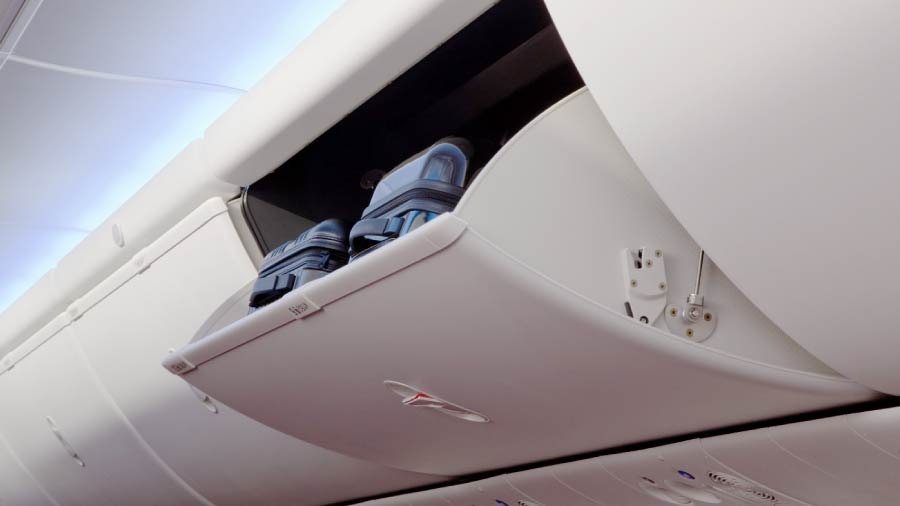
737 Space Bins are a Boeing cabin retrofit that expands usable overhead carry-on capacity by 50% or more on 737NG and 737 MAX aircraft.
Each bin holds up to six standard carry-on bags, compared to the three or four that fit on a conventional shelf or in a standard pivot bin. A lower lip height and redesigned bin opening make loading faster and easier for crew as well, reducing the time required to stow bags and close overhead bins during boarding.
The numbers tell the story clearly:
| 737 Model | Space Bins | Shelf Bins | Standard Pivot Bins |
|---|---|---|---|
| 737-700 | 144 bags | 52 bags | 94 bags |
| 737-800, 737-8 | 178 bags | 70 bags | 118 bags |
| 737-900ER, 737-9 | 200 bags | 77 bags | 134 bags |
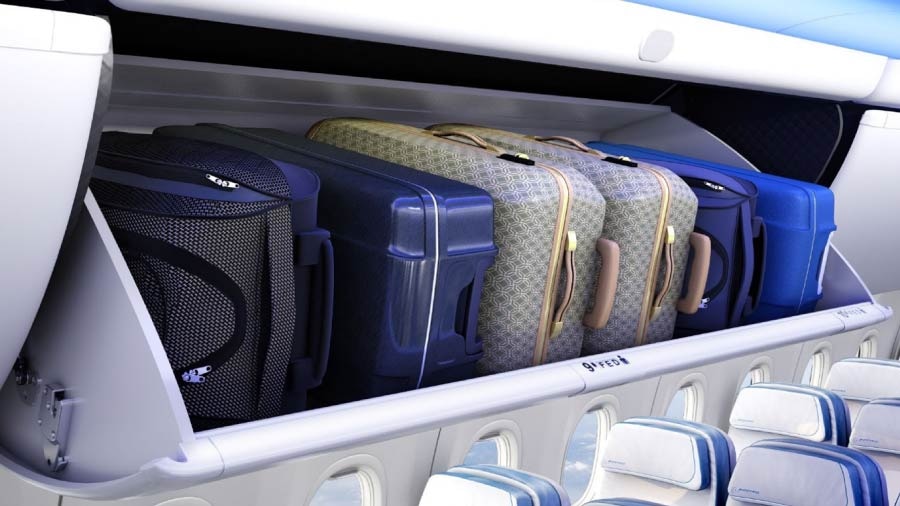
More overhead bin space means nearly every passenger boards with a reliable place for their carry-on. What's more, boarding flows faster because crew aren't stopping to manage exceptions.
Space Bins are engineered specifically for Boeing Sky Interior (BSI) layouts on 737NG and 737 MAX platforms. The retrofit uses the same design, materials, and quality standards as factory-installed Space Bins, and it can be completed within a standard C-check window to minimize downtime.
Based on modeled fleet economics for a 737-8 operating at an 80% load factor with 1,415 annual flights, the yearly per-aircraft benefits from Space Bins include:
These aren't abstract projections but what actually happens when boarding becomes consistent, gate checks drop, and your aircraft spend more time in the air.
Since their introduction, Space Bins have accounted for more than 65% of delivered overhead bin upgrades on 737 BSI installations — a strong signal that operators who run the numbers find the benefits compelling.
Boeing's own passenger research identified bin space as the single biggest driver of perceived cabin improvement, which directly connects increased overhead capacity to a higher NPS and stronger passenger loyalty.
If your 737 fleet still uses shelf bins or standard pivot bins, you're needlessly absorbing costs and losing revenue.
Gate-check handling fees, rebooking expenses, bag transfer labor, and ground time tied to boarding delays all shrink when bin capacity increases. Lower hold volume that currently absorbs carry-on overflow becomes monetizable cargo capacity. And passengers who board without the stress of finding overhead bin space are far more likely to have a positive experience.
The retrofit path varies by your current bin configuration. Upgrading from BSI pivot bins to Space Bins requires no structural changes and reuses the majority of existing parts, keeping both installation time and cost predictable.
Upgrading from shelf bins delivers the full BSI refresh alongside the capacity gain, which includes new ceiling panels, LED lighting, updated sidewalls, and a more modern-feeling cabin.
Both paths ultimately deliver the same outcome: more overhead bin space for carry-ons, faster boarding, and better economics per flight.
Explore our 737 Space Bins today and request a tailored value story built around your fleet to learn what our retrofit solution can deliver for your operation.